
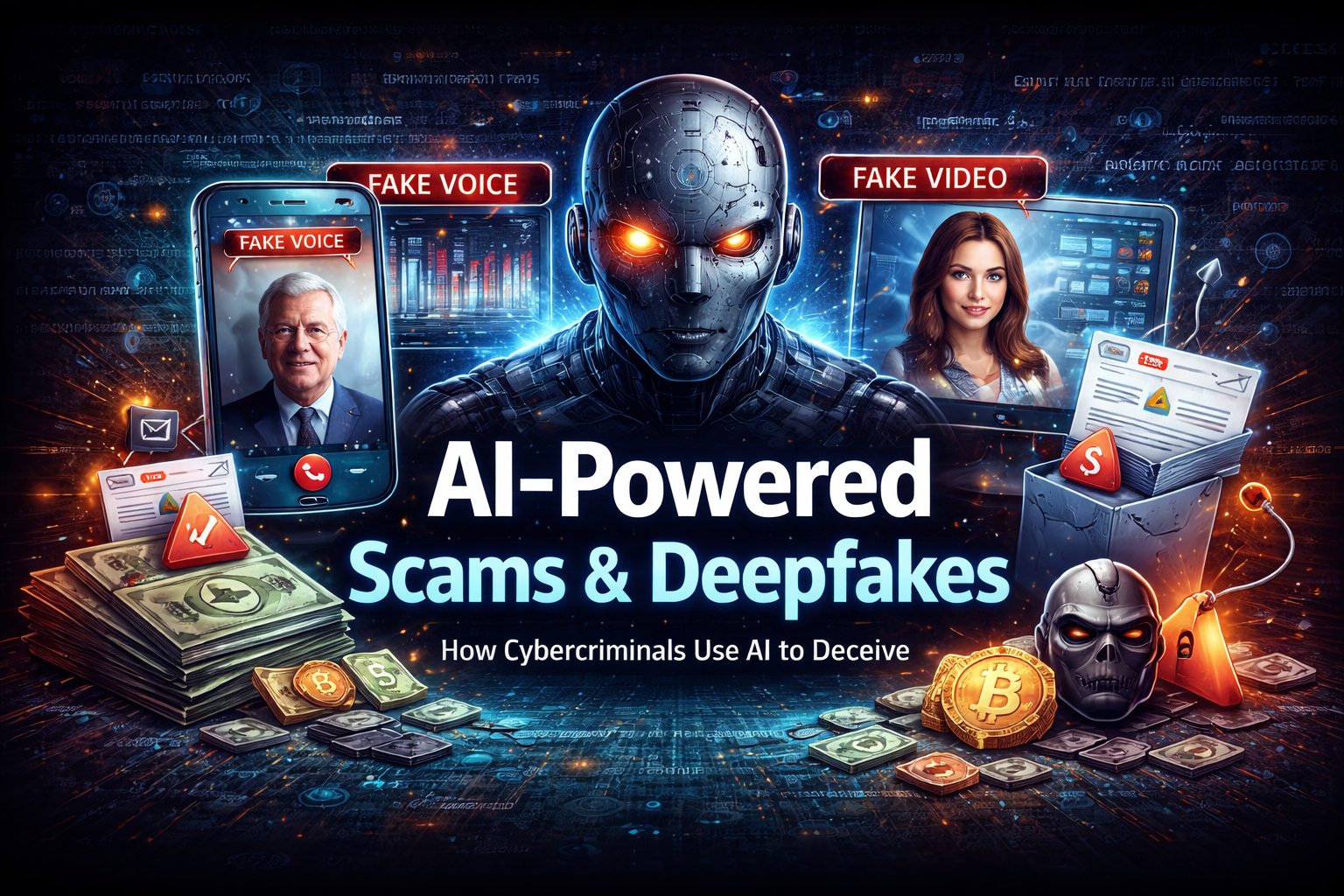
Introduction
Artificial Intelligence is transforming industries — but it is also empowering cybercriminals.
A growing number of fraud cases now involve AI-powered scams, including voice cloning, deepfake videos, and highly convincing phishing messages. These attacks are no longer easy to spot, and in many cases, even security-aware users are being deceived.
Recent trends show that a significant percentage of digital finance users have encountered fraud attempts linked to AI-driven techniques.
The reality is simple:
Scammers no longer need to hack systems — they can now imitate you.
What Are Deepfakes?
Deepfakes are AI-generated or AI-manipulated:
- Videos
- Audio recordings
- Images
They are designed to look and sound like real people.
Attackers can:
- Clone your voice from a short recording
- Use your photos to generate fake videos
- Impersonate trusted individuals (family, colleagues, bank officials)
This creates a dangerous layer of identity deception.
Common AI-Powered Scams You Should Know
🎙️ Voice Cloning Calls
Scammers collect a few seconds of your voice from:
- Social media videos
- Voice notes
- Phone recordings
They then use AI tools to replicate your voice and call your contacts.
Typical scenario:
“I’m in trouble, please send money urgently.”
Because it sounds like you, victims often act without verification.
🎥 Deepfake Video Calls
Fraudsters use real-time face-swapping technology to impersonate:
- Bank officials
- Executives
- Business partners
They may request:
- Account details
- One-Time Passwords (OTPs)
- Urgent financial approvals
These attacks are especially dangerous in corporate environments.
✉️ AI-Generated Phishing Messages
Traditional phishing used to be easy to detect due to poor grammar.
Not anymore.
AI now generates:
- Perfectly written emails
- Personalized messages
- Context-aware communication
These messages can mimic:
- Banks
- Fintech apps
- Government agencies
💰 Fake Investment Promotions
Scammers create deepfake videos of:
- Celebrities
- Business leaders
- Financial experts
Promoting “guaranteed returns” or “exclusive investment opportunities.”
These scams rely on trust and authority manipulation.
Why AI Scams Are More Dangerous
From a security perspective, AI-driven attacks introduce:
- High realism – difficult to distinguish from legitimate communication
- Scalability – attackers can target thousands of victims simultaneously
- Personalization – tailored attacks using publicly available data
- Reduced technical barriers – attackers don’t need advanced hacking skills
This marks a shift from technical exploitation → psychological manipulation at scale.
Real-World Impact
Victims of AI-powered scams may experience:
- Financial loss
- Identity theft
- Unauthorized account access
- Reputational damage
- Compromise of corporate systems
In enterprise settings, these attacks can escalate into:
- Business Email Compromise (BEC)
- Insider impersonation
- Fraudulent fund transfers
How to Protect Yourself
✅ For Individuals
- Verify before acting
- Always confirm urgent requests via a second channel
- Limit what you share online
- Avoid posting clear voice recordings unnecessarily
- Be cautious of urgency
- Scammers rely on panic and pressure
- Never share sensitive information
- OTPs, passwords, PINs should never be requested
- Watch for inconsistencies
- Slight voice delays, unnatural facial movements, or odd requests
🛡️ For Organizations
- Implement Zero Trust verification policies
- Enforce multi-factor authentication (MFA)
- Train employees on deepfake awareness
- Monitor for abnormal communication patterns
- Establish verification protocols for financial transactions
SOC Analyst Perspective
From a defensive standpoint, AI-powered scams are harder to detect because they:
- Do not rely on traditional malware signatures
- Often bypass technical controls
- Exploit human trust rather than system vulnerabilities
Detection strategies should include:
- Behavioral analysis
- Communication pattern anomalies
- Identity verification workflows
- Threat intelligence on emerging AI fraud techniques
AI is not just enhancing cybersecurity — it is also enhancing cybercrime. The strongest defense is no longer just technical — it is awareness and verification. If a request involves urgency, money, or sensitive data — pause and verify.
As AI continues to evolve, so will the tactics of cybercriminals. Users must adapt by becoming more cautious, more aware, and less reactive.
Trust is no longer enough.
Verification is now essential.